
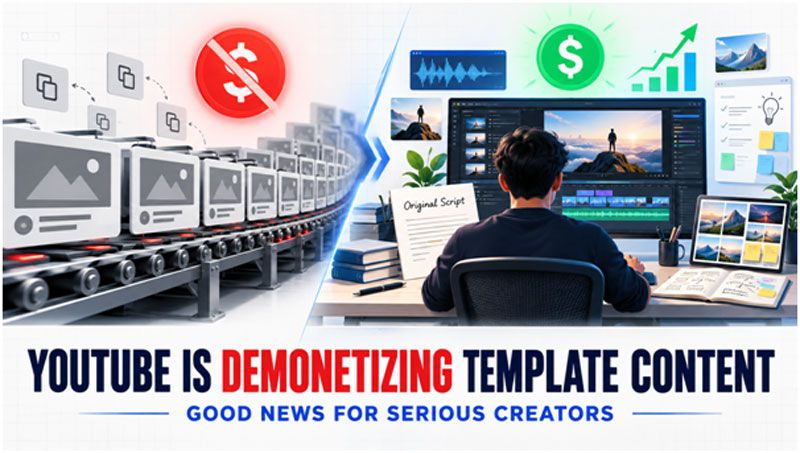
It is tempting to read this as good creators winning and bad ones losing. That is not what the policy does, and reading it that way is how careful people get caught out.
YouTube’s inauthentic content policy does not distinguish sincere creators from cynical ones. It distinguishes channels where a person made decisions from channels where a process ran. Plenty of hardworking people are on the wrong side of that line, because they adopted a workflow built to maximise output and the workflow quietly took over the decisions.
So before the celebration, it is worth checking which side you are actually on.
What the policy targets
The policy was renamed from repetitious content in July 2025 and expanded since. What it excludes from monetisation is generic or repetitive output where each video closely resembles the last, including AI-generated material built on unoriginal templates.
Note what is not on that list. YouTube’s own guidance explicitly permits using AI to draft scripts and generate visuals. The tools are not the problem, and any article telling you AI causes demonetisation has not read the policy.
Two further details matter. The assessment is made at channel level rather than video by video, and reviewers look at a channel’s main theme, its most-viewed videos, its newest uploads, the videos carrying the largest share of watch time, the metadata and the About section. A separate reused content policy applies to material repurposed without meaningful original contribution, and it is also assessed across the whole channel.
System versus template
This is the distinction that decides everything, and it is simpler than it sounds.
A system is a repeatable process. A template is a repeatable output.
A system means you follow the same workflow each week: choose a topic, verify demand, write the packaging, script, produce. The process is identical every time and the videos are not, because you made different decisions inside it.
A template means the output has a fixed shape and you swap the variables. Same structure, same pacing, same phrasing, different subject dropped into the slots. The process saves you from thinking, which is precisely the thing being penalised.
Here is the test. Take the transcripts of your seventh and twelfth videos, swap the topic names, and see whether anyone could tell. If they read as the same video with different nouns, you have a template. If the argument, the structure and the emphasis genuinely differ, you have a system.
Systems are good. Build one. Just make sure it is repeating your process rather than your output.
Why this is genuinely good news
Not because anyone gets punished, but because of what it does to the returns on effort.
Production used to be a moat. Being able to write, narrate and edit well kept the field small. AI removed that moat for everyone simultaneously, and for about two years the winning move in many niches was simply volume. A channel publishing thirty templated videos a month could out-earn one publishing four thoughtful ones, because impressions went to whoever filled the space.
The policy changes that arithmetic. Volume without judgement is now a liability rather than an advantage, which means the hours you spend choosing a subject properly, finding an angle nobody covered and writing something you actually believe are worth more than they were.
There is a second effect. The niches most flooded with templated channels were the ones where it was hardest to be seen. As those channels lose monetisation and stop publishing, the competition for impressions in those niches thins.
Neither of these guarantees anyone anything. But the work that was previously drowned by volume now has a better chance of surfacing.
What actually adds the missing element
Practical, in rough order of impact.
Commentary rather than narration. The difference between reading facts aloud and telling someone what you think they mean. This is the single largest gap in most templated content.
One original input per video. Your own research, your own test, your own experience, a number you worked out yourself. One thing that was not in the source material.
Structural variety. If your last ten videos open identically, vary them deliberately. Reviewers look at recency, so the newest uploads matter most.
A point of view. Two channels can cover the same subject and be entirely distinct if each has a position. Most templated content has none, which is why it is interchangeable.
Human editing of the draft. Read it aloud and cut anything you would not say. This catches more generic phrasing than any tool.
A checklist before you publish
- Could someone tell two of my videos apart from transcripts alone?
- Does this video contain at least one thing that was not in my sources?
- Is there commentary, or only narration?
- Do my last ten uploads have visibly different structures?
- Is my About section written by a person, about a person?
- Can I name the specific decision I made on this video?
If you cannot answer the last one, the process made the video rather than you.
The honest close
None of this guarantees monetisation, and plenty of original channels never reach the threshold at all.
What has changed is that the thing separating a good channel from an ignorable one is now also the thing separating a monetisable channel from a demonetised one. Those used to be different problems. They are now the same problem, which is convenient, because you only have to solve it once.
Frequently asked questions
Does using AI cause demonetisation?
No. YouTube’s guidance explicitly permits using AI to draft scripts and generate visuals. What it excludes is generic, template-based output where each video closely resembles the last and no human judgement is visible. The distinction is not whether AI was used, but whether a person made the decisions.
What is the difference between a content system and template content?
A system is a repeatable process; a template is a repeatable output. A system means following the same workflow each week while making different decisions inside it. A template means fixing the shape of the video and swapping the variables, which produces uploads that are effectively interchangeable.
Can a faceless channel still be monetised in 2026?
Yes. Nothing in the policy excludes faceless formats, synthetic narration or AI-assisted production. What it excludes is output that looks mass-produced. A faceless channel with original research, genuine commentary and varied structure sits comfortably inside the rules.
How does YouTube assess this?
At channel level rather than video by video. Reviewers look at the channel’s main theme, most-viewed videos, newest uploads, the videos carrying the largest share of watch time, the metadata and the About section. Recency is explicitly included, so a clean-up done long ago protects nobody.
What if my channel is already templated?
Start with the newest uploads, since recency is part of the assessment. Add commentary and one original input per video, vary the structure deliberately, and rewrite the About section. Deleting old videos is usually a mistake, because the monetisation threshold counts public watch hours and removing uploads takes those hours out of your total.

Reblog It collaborates closely with clients to develop tailored guest posting strategies that align with their unique goals and target audiences. Their commitment to delivering high-quality, niche-specific content ensures that each guest post not only meets but exceeds the expectations of both clients and the hosting platforms. Connect with us on social media for the latest updates on guest posting trends, outreach strategies, and digital marketing tips. For any types of guest posting services, contact us on reblogit.webmail[at]gmail.com.